
1892
Jonas Øgländ's eldest son Jakob returns home after a long stay in Germany. He brings with him, among other things, an agency for Hengstenberg bicycles. He establishes Øglænd Cyklelager, but very few bikes are sold.
1897
Jakob is joined by his brother Lars and together they secure the Scandinavian agency for the American bicycle «The World» from Arnold Schwinn & Co. The bikes arrive dismantled from the USA in large numbers. They rent premises in Jærveien 21-23, where they have a bicycle warehouse in the attic and an assembly and repair workshop in the living room. The Øglænd brothers shared responsibility between them; the youngest, Lars, took over production and Jakob sales.
1898
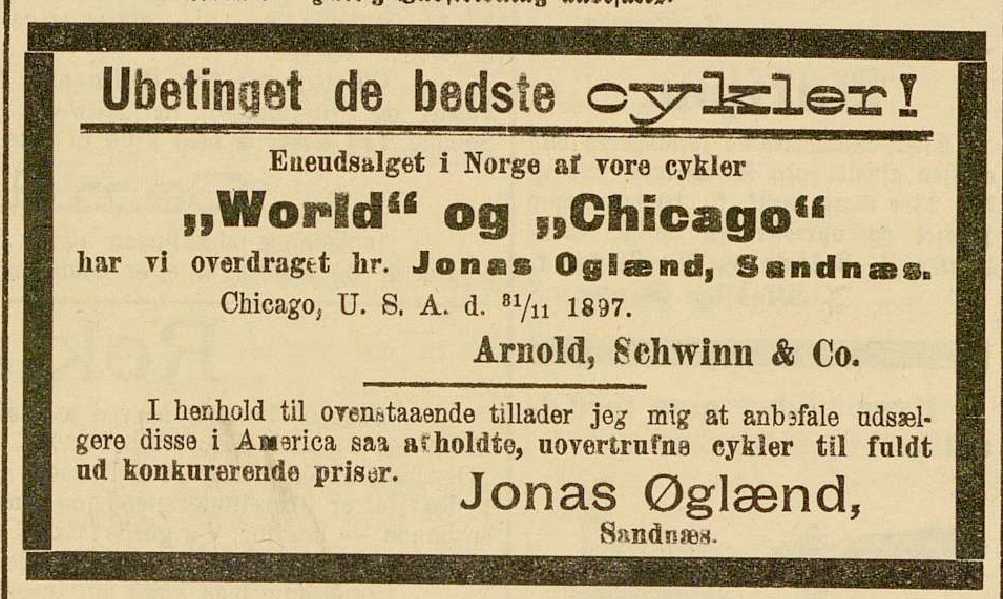
1898
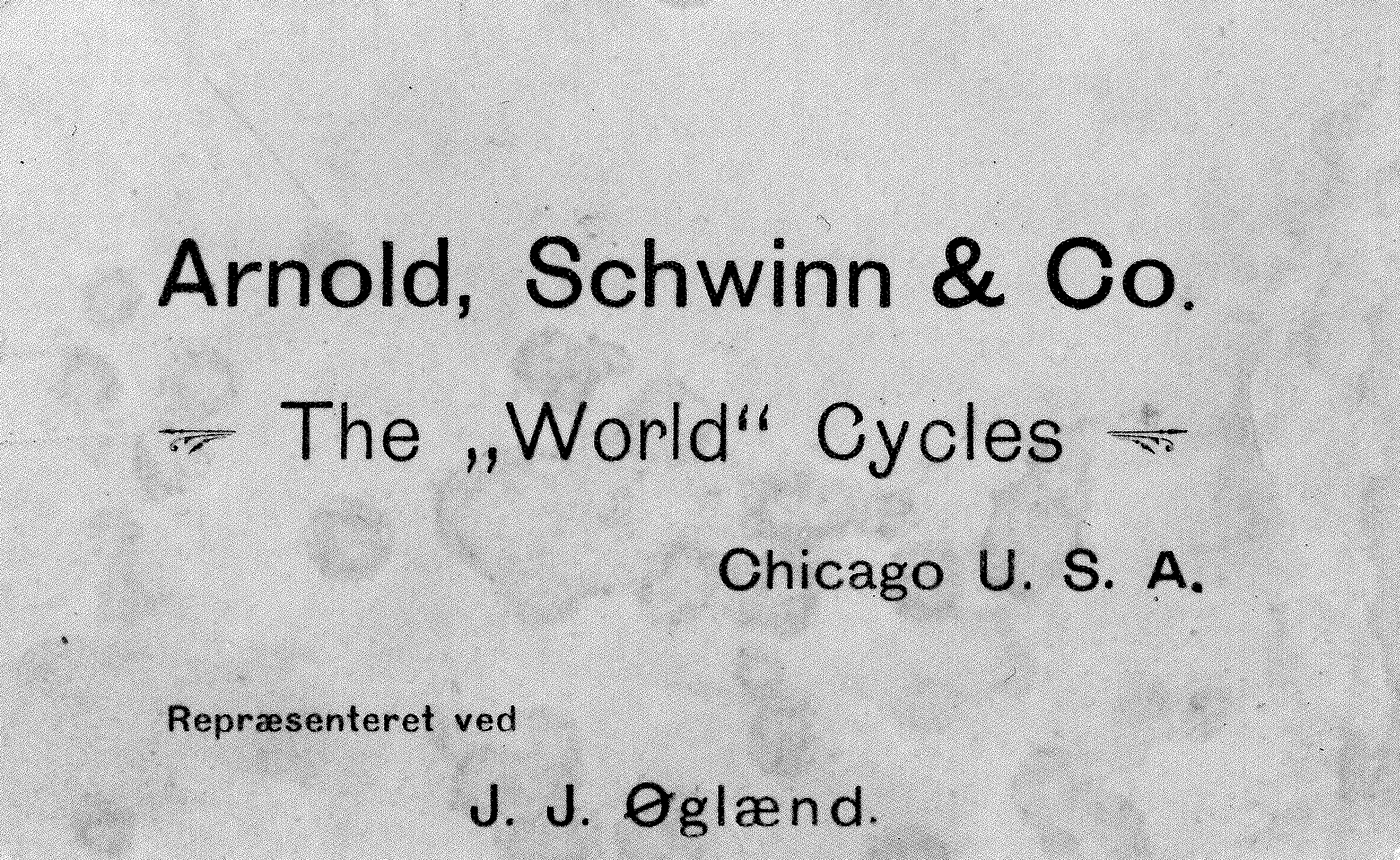
1899
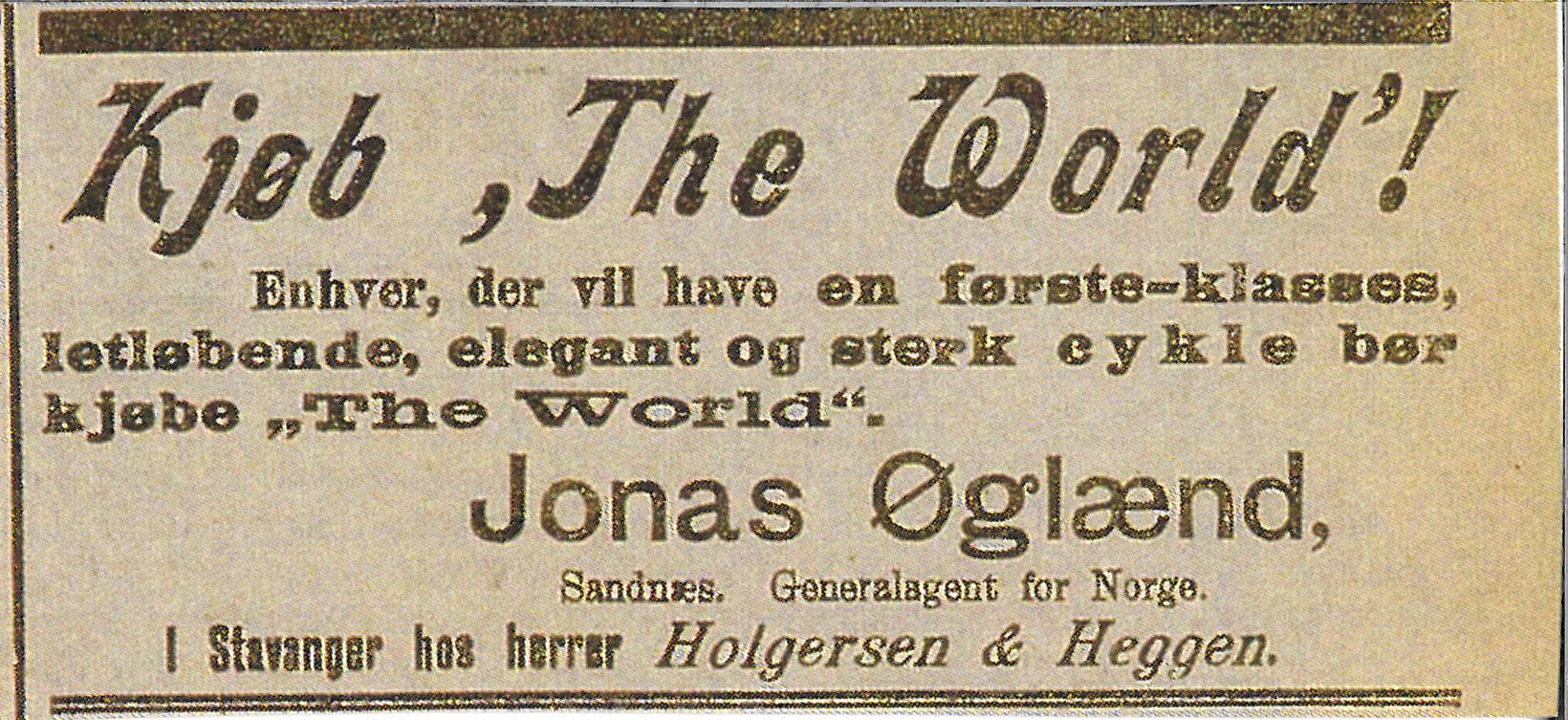
1900
Around the turn of the century, the company also began producing its own bicycles under the names «Fram» and «Viking».
1903
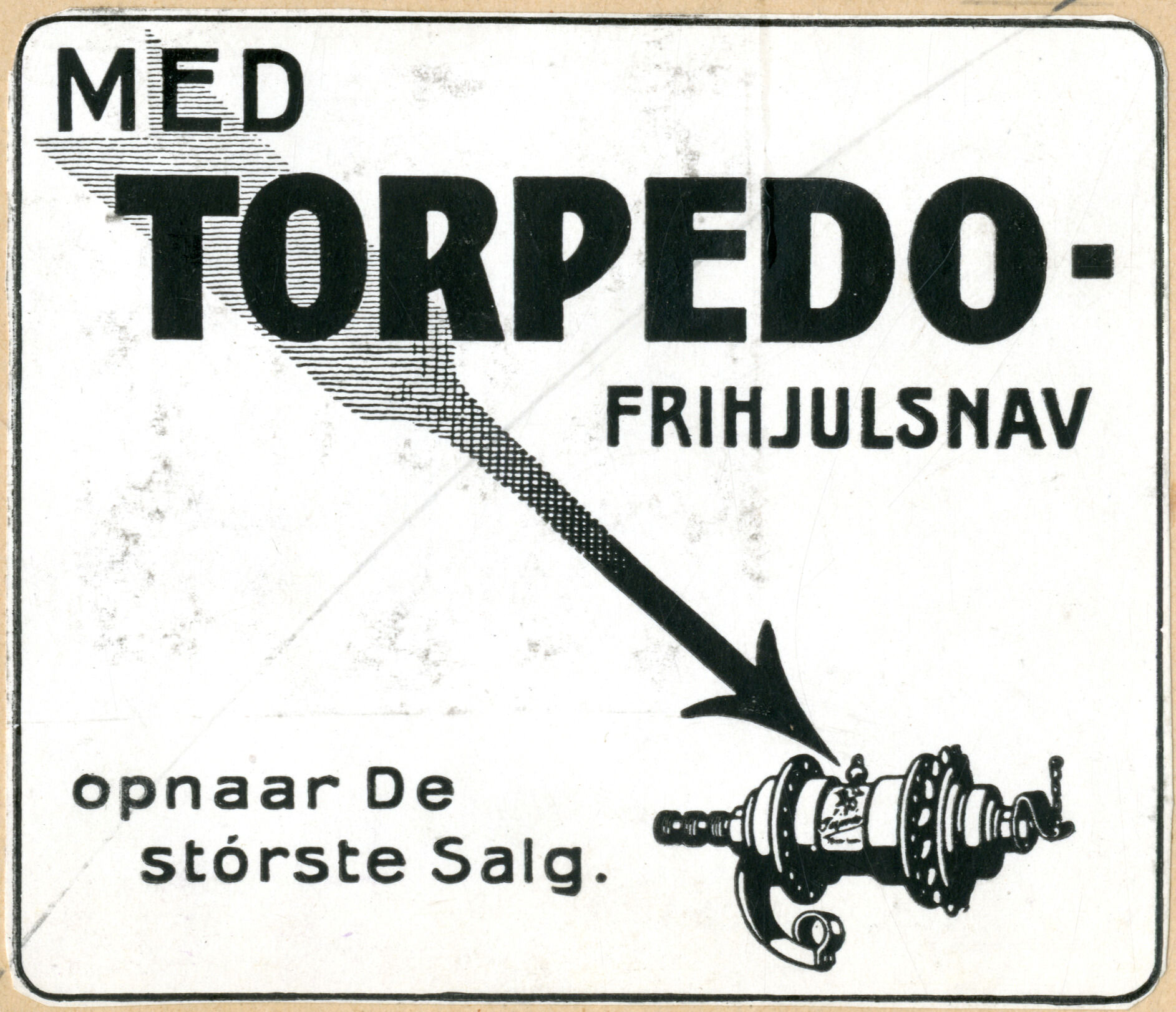
Øglænd becomes the exclusive Norwegian distributor for German Fichtel & Sach's newly invented «Torpedo» freehub. This is the start of a long and fruitful collaboration between Øglænd and Sach.
1904
The brothers buy their first motorcycle, a German machine. Petrol had to be bought in bottles from a pharmacy and they had to go to the Victoria Hotel in Stavanger to charge the battery.
1906
Progress in bicycle production is much greater than Jonas Øglænd had predicted. The brothers and their father enter into a full partnership and focus on bicycles.
1906
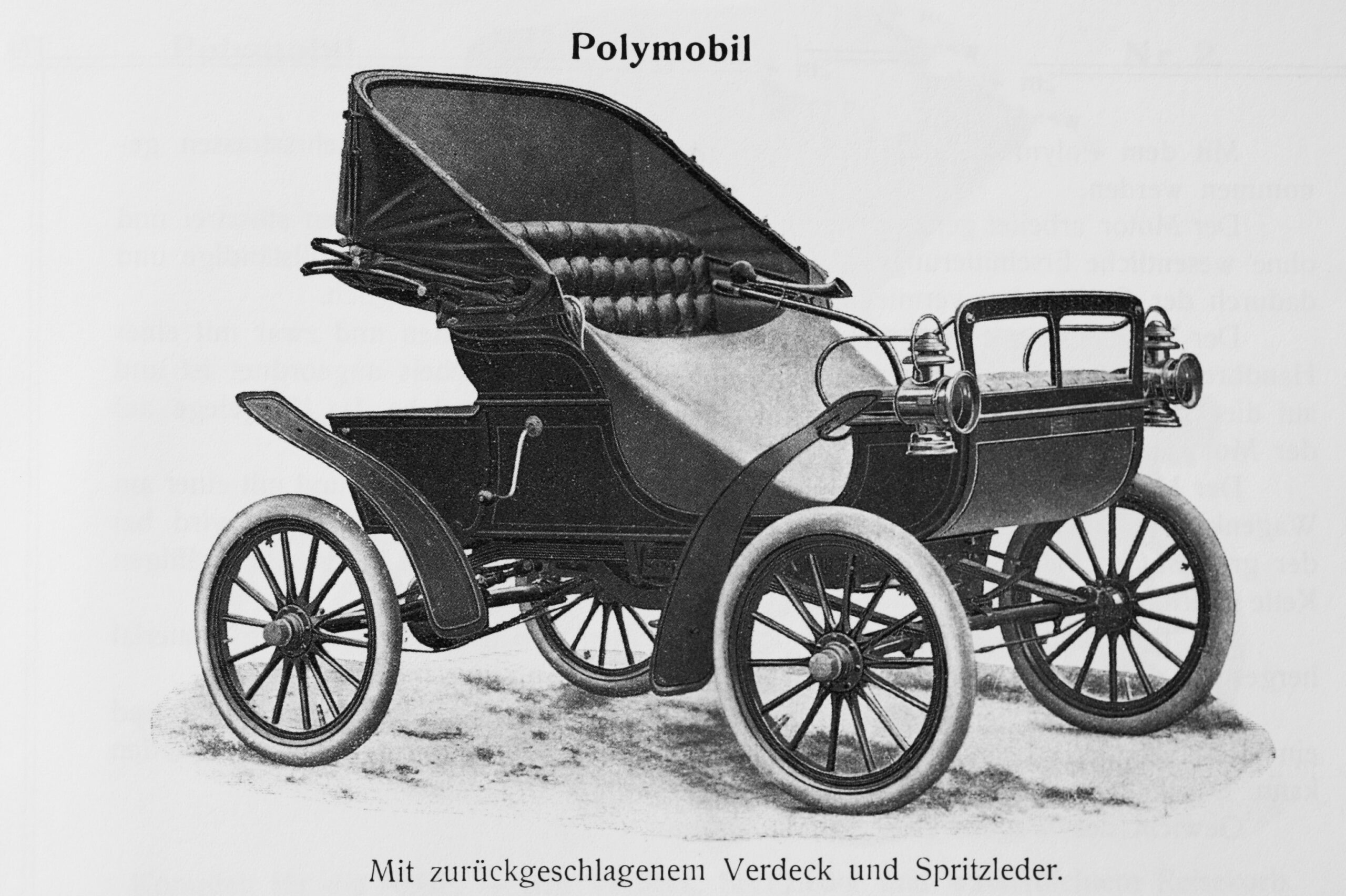
Lars and Jakob buy a car on their trip to Germany. A «Polymobil» is purchased, transported by boat to Stavanger, and driven home by Lars. At Hinna, the car needs to be refilled with water. The top speed is approx. 20 km/h.
1906
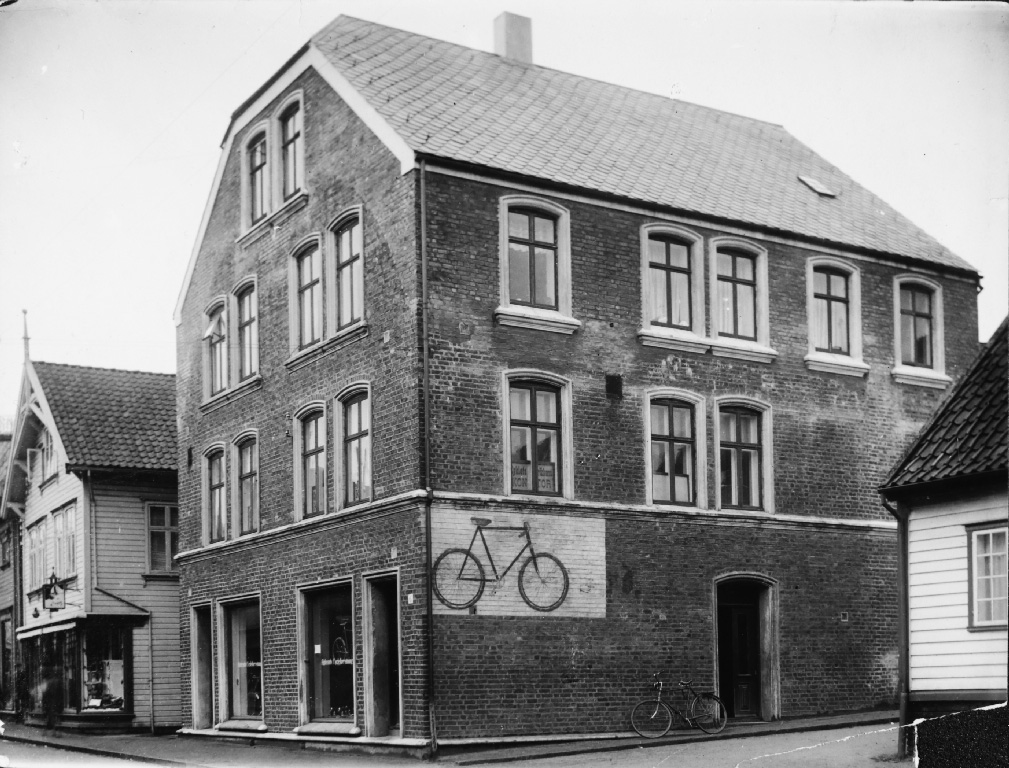
Øglænd buys Langgt. 6 and the bicycle factory moves into its own premises for the first time. The workforce consists of 4-5 employees.
1909
A new 2 ½-storey building is built just behind the bicycle factory in Langgt. 6, where a nickel-plating, grinding and polishing workshop was set up. The aim is to become as self-sufficient as possible in production.
1911
New 2 ½-storey building at Erling Skjalgssons gate 10. The building is called «Automaten» because of its large automatic lathes.
Sykkelfabrikken acquires large parts of the Solaveien, Eidsvollsgata, Erling Skjalgssons gate and Storgata blocks.
1912
A single-storey forge building is built on the site in Solaveien.
1913
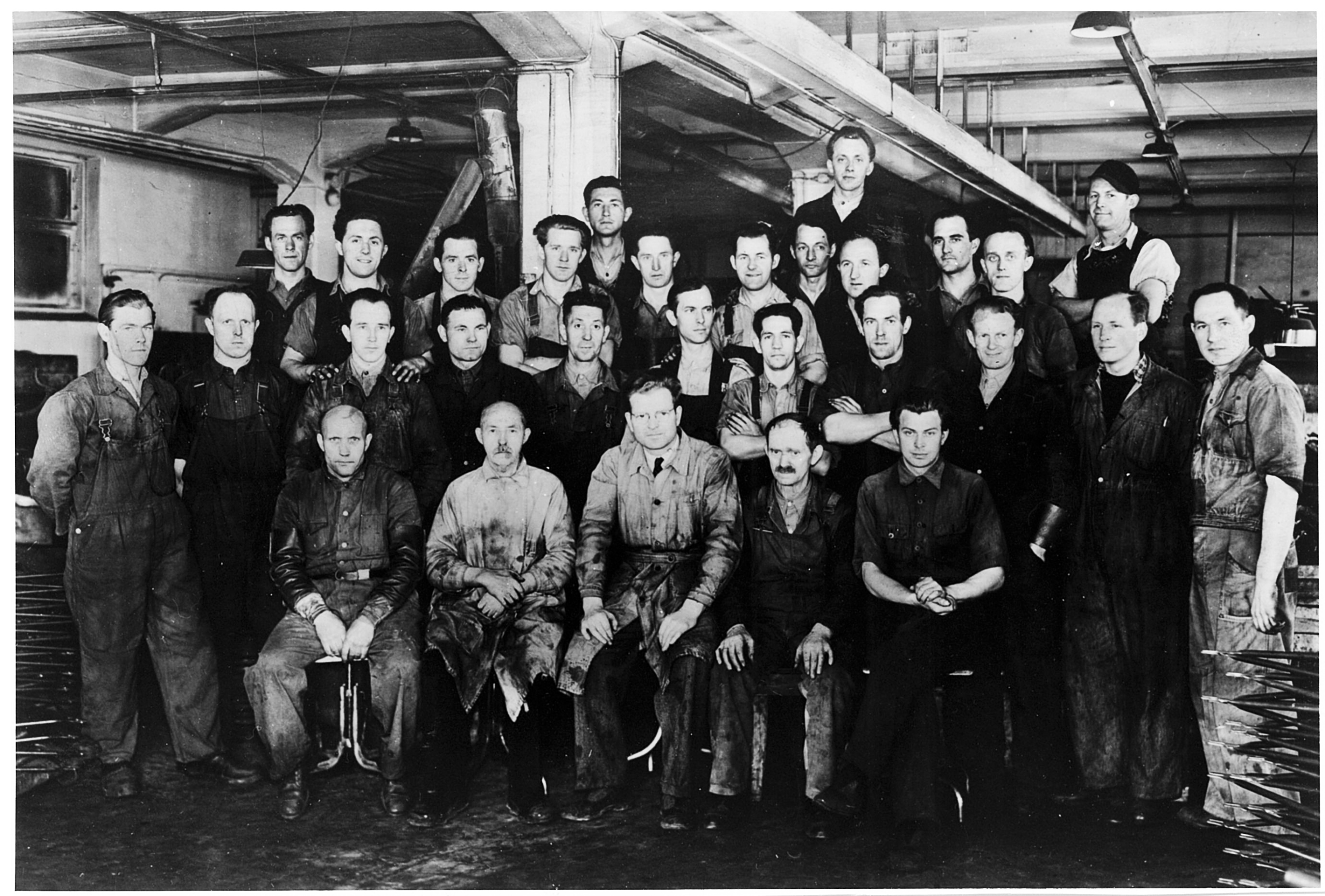
A new building is built in Solaveien; a large 2 ½ storey brick building with a floor area of 1565 square meters. The building houses the paint department, bicycle assembly and storage for frames and bicycles. It is popularly known as «Rammeverkstedet».
1914
The bicycle workers form their own trade union club. Around 55-60 of the bicycle factory's 95 employees join. Wage negotiations break down and the bicycle factory's first strike is a fact. After a three-week strike, the arbitration court accepts Øglænd's view and the strike is called off. The club has not achieved anything and is closed down shortly afterwards.
1914
In June, Jakob is on a shopping trip to Germany. During his stay, he receives news of the murder of the Austrian heir to the throne in Sarajevo. Jakob follows advice to purchase large orders before war breaks out.
1916
Jakob's eldest son, Jonas Bjarne Øglænd, travels to New York to gain practical business experience as a further education. Many necessary deliveries are made and Jonas Bjarne establishes his own purchasing office in the USA in 1917.
1918
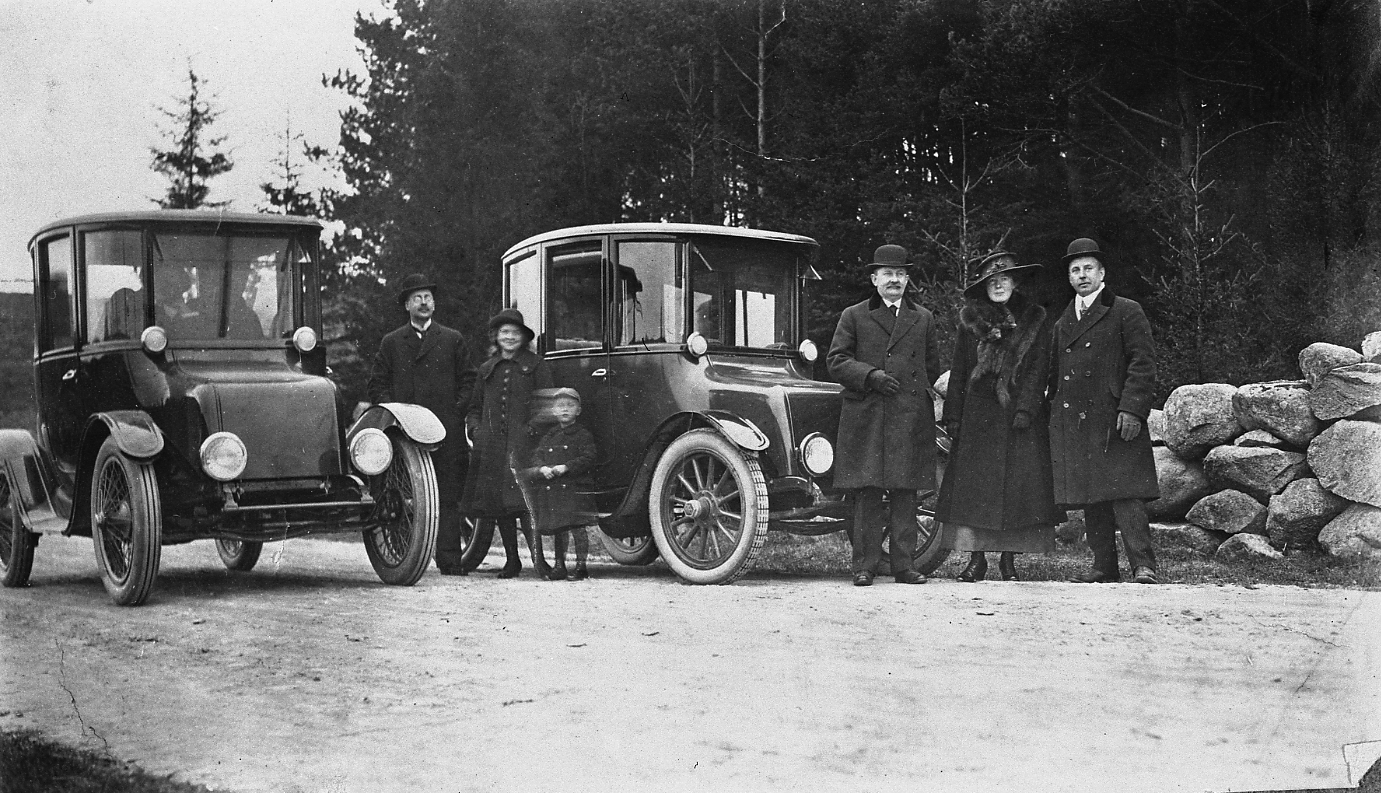
On January 10, the Norwegian Bicycle Manufacturers and Wholesalers Association is founded. One of the aims of the association was to ensure regular deliveries to bicycle manufacturers.
Øglænd celebrates its 50th anniversary.
Øglænd sets up a relief fund for the workers.
1921
Major strike in Norway that also affects Øglænd bicycle factory. The strike ends on June 10th, after about 14 days. The workers lose the strike and 13 employees are dismissed, the vast majority of whom were unionized. Throughout 1921, Øglænd had to resort to further redundancies. The number of employees fell from 110 in 1920 to 58 at the end of the year. The recession and stronger competition from abroad put Øglænd in a difficult situation.
1923
The market is turning somewhat, and Øglænd is focusing even more on in-house production of bicycle parts.
1925
In the middle of the decade, Øglænd starts making «Junior» children's bikes. These are adapted for 5-12 year olds and become a success. Production of tricycles is also initiated.
1930
This year, 4,895 bicycle frames will be produced. Øglænd has approximately 40 % of the Norwegian market.
1931
Jonas Bjarne Øglænd returns home from New York and joins the bicycle factory's management team.
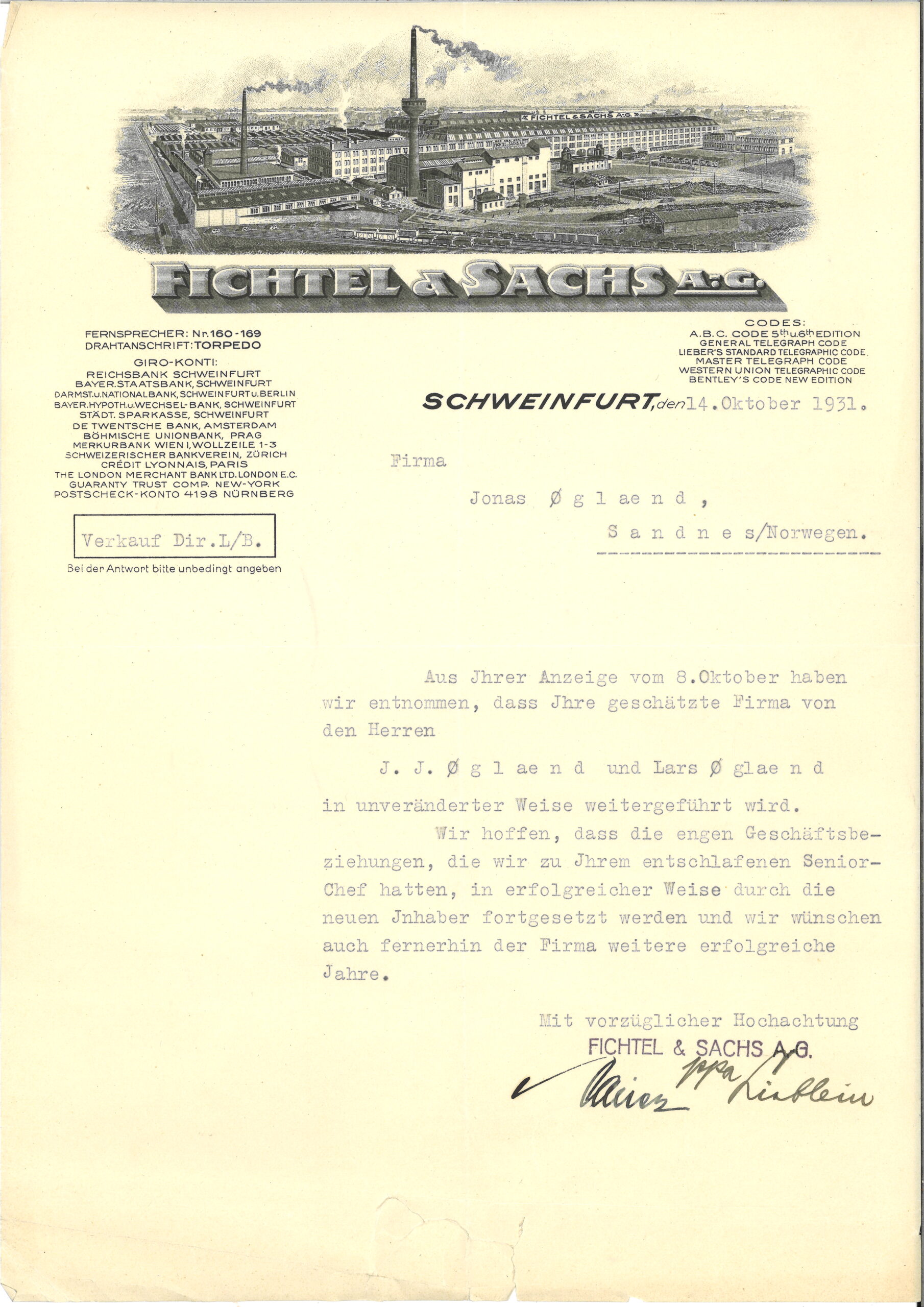
Jonas Øglænd dies at the age of 84. Jakob and Lars Øglænd take over the company.
The Sachs Group in Germany launches it’s Sachs motor. Øglænd’s sykkelfabrikk becomes the exclusive distributor for the engine in Norway.
Motorcycle production starts up under the brand name «The World». Available only with Sachs engines.
Both the motorcycles and the pedal bikes are improved with chrome nickel plating, rust protection and finishing. The drum brake is launched for the bicycle.
1931
1933
D.B.S - Den Beste Sykkelen (The best bike). Øglænd arranges a naming competition, as Øglænd's bikes were almost entirely locally made. The new name should be easy and Norwegian. 12-year-old Knut Johannessen came up with the idea.
1934
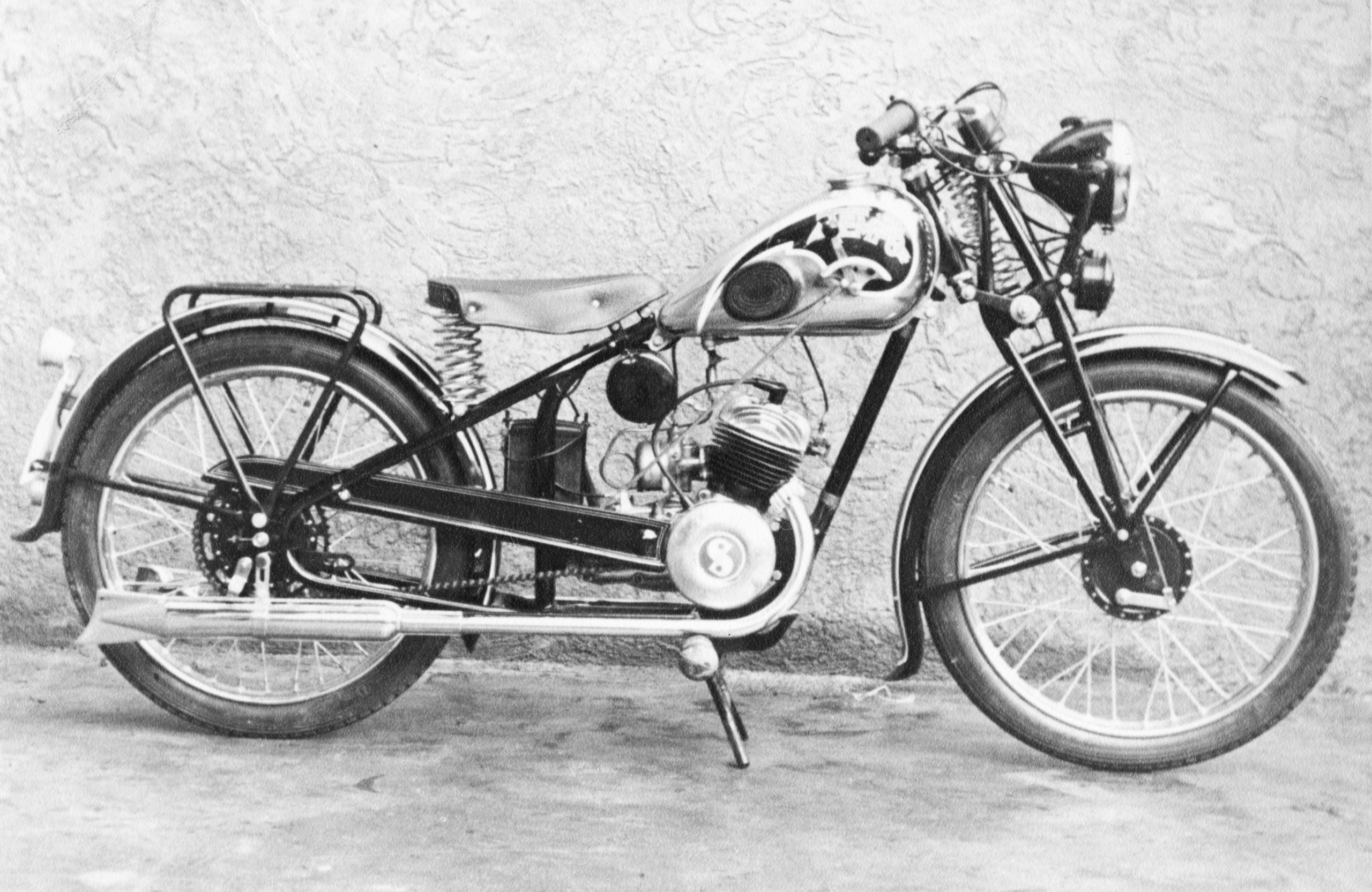
«The World» motorcycle gets a new brand name - «Tempo.
1935
Øglænd now accounts for 2/3 of Norway's total bicycle production.
1938
Øglænd makes an agreement with the engine manufacturer Villiers in England and includes this engine in the model range.
1940
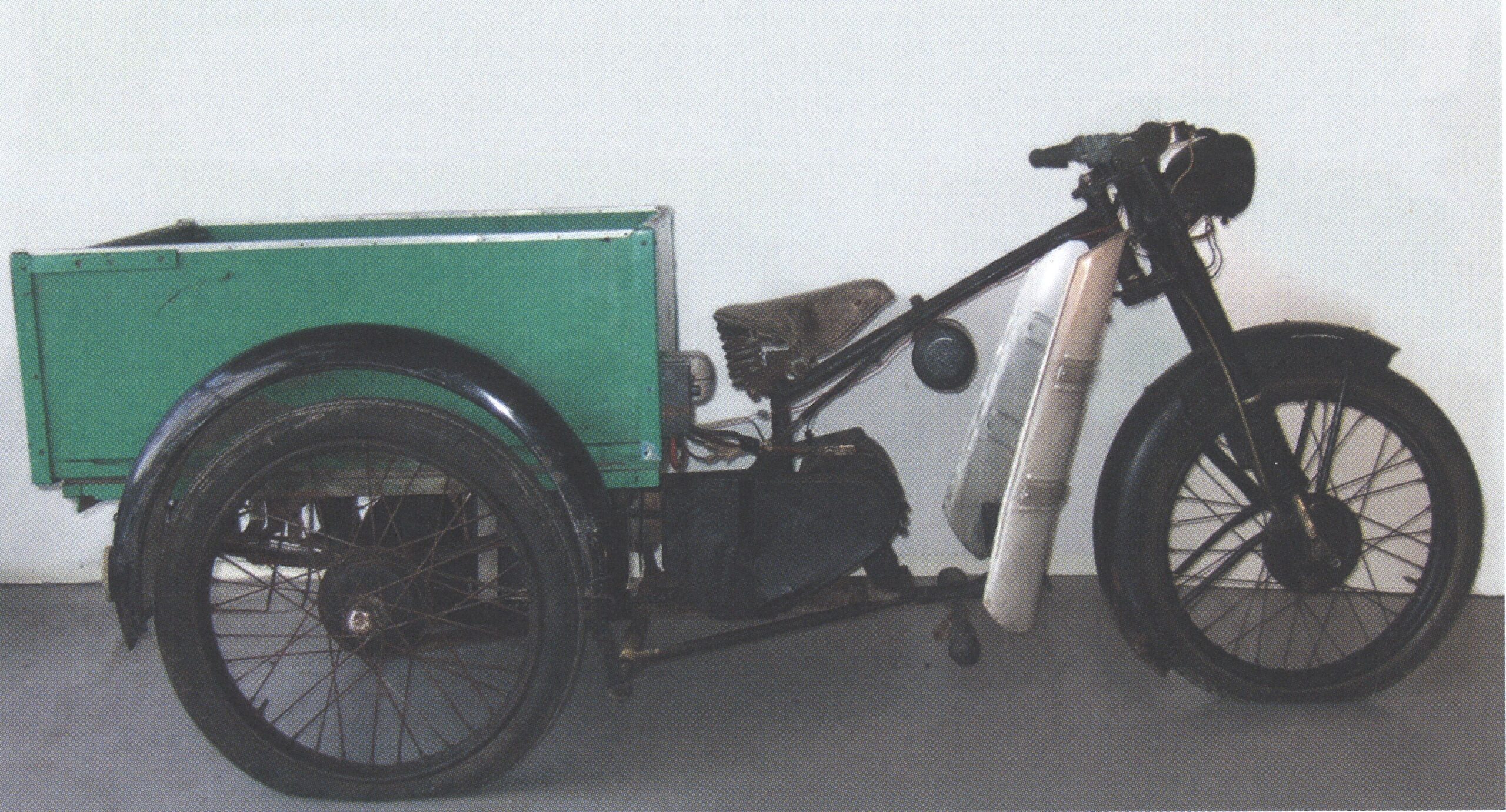
Starts production of Tempo Elektro transport bike, with Norwegian electric motor (NEBB). First bike with differential.
1940
This year, Øglænd produces 62,450 bicycle frames.
Einar Andreassen, an employee of the bicycle factory, starts Rogaland's first illegal newspaper «Stridt Folk» in protest against the NS magazine «Fritt Folk».
1941
A new building in Solaveien 10 is erected.
1942
Øglænd builds a pedestrian bridge between Solaveien 3 and 10, decorated with reliefs.
1943
The Øglænd company celebrates it’s 75th anniversary. A large anniversary book is published.
1949
First bicycle export starts.
1950
Jakob Øglænd dies, 75 years old.
1950
In the 1950s, several motorcycle models are launched. Among the most popular are Tempo Standard, Tempo Swing, Tempo Sport and Cross.
1950
Planning for a new bicycle factory in Vågen begins.
1951
«The Tempo Victoria » is launched. It has a 38 cc engine, 1 hp and a speed of a staggering 25-30 km/h. This was the forerunner of the moped.
1951
1951 Bicycle frame no. 1 million is produced and sales reach NOK 25 million.
1951
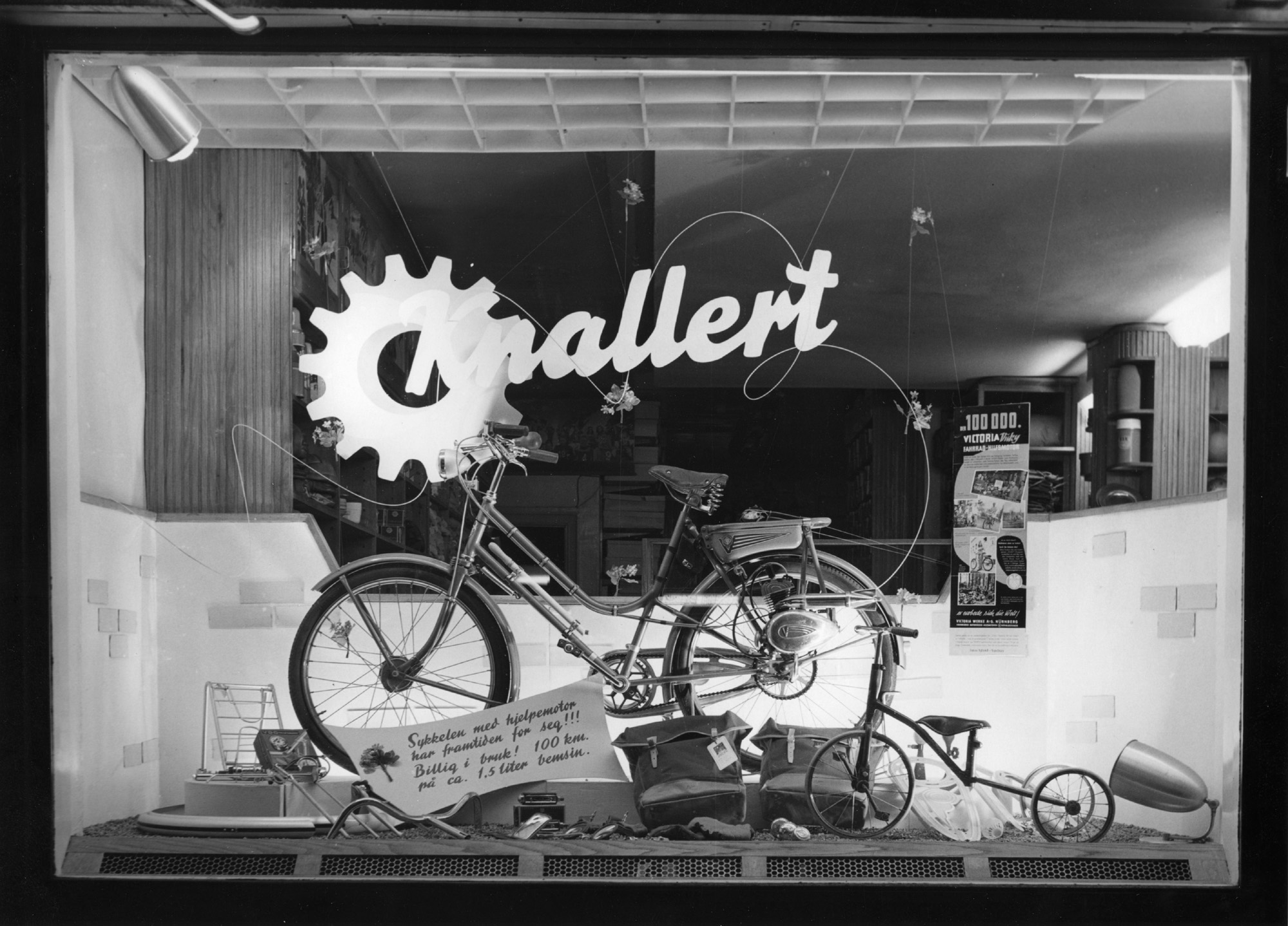
«The Tempo Victoria »moped" is launched. It has a 38 cc engine, 1 hp and a speed of a staggering 25-30 km/h. This was the forerunner of the moped.
1953
The first moped, Tempo Handy is launched. 48 cc, 1.25 hp. Top speed 35-40 km/h.
1953
Lars Øglænd dies, 73 years old.
Greater momentum in exports, especially bicycle frames to Finland.
1957
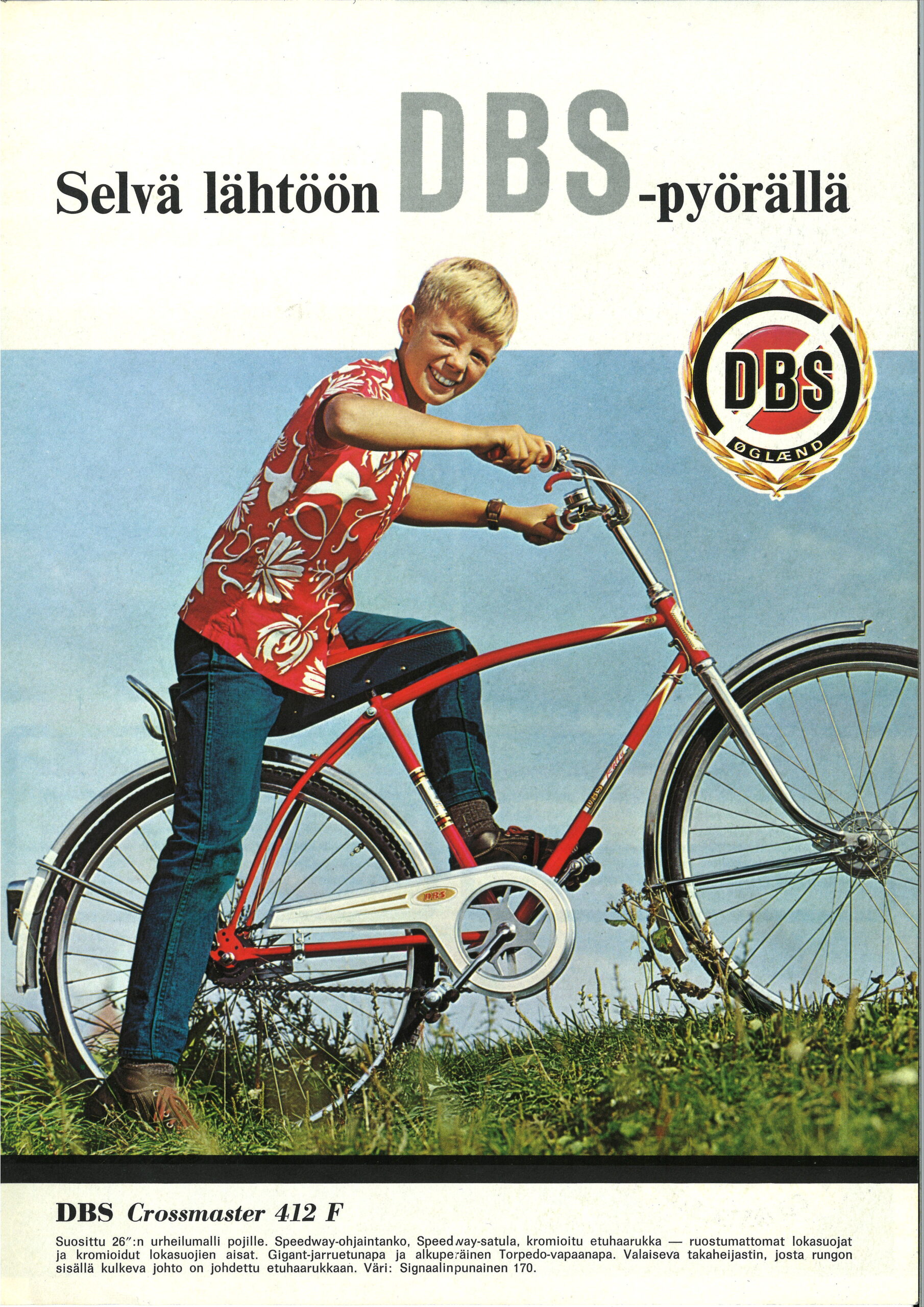
1960
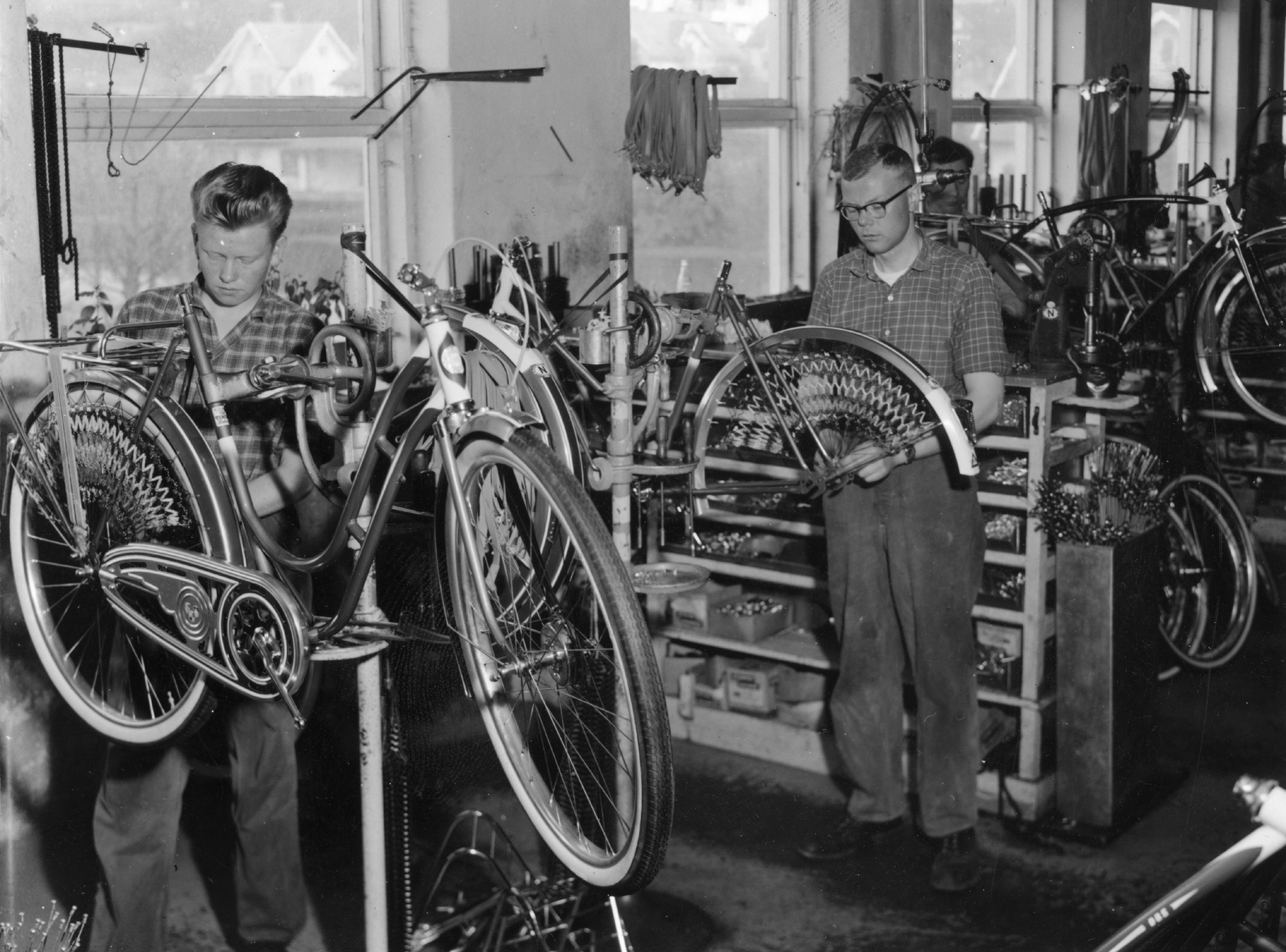
Bicycle exports to Sweden start up.
1960
111,028 bicycle frames are produced this year.
1960
Tempo Corvette is launched. Becomes Øgländ's most popular moped.
1960
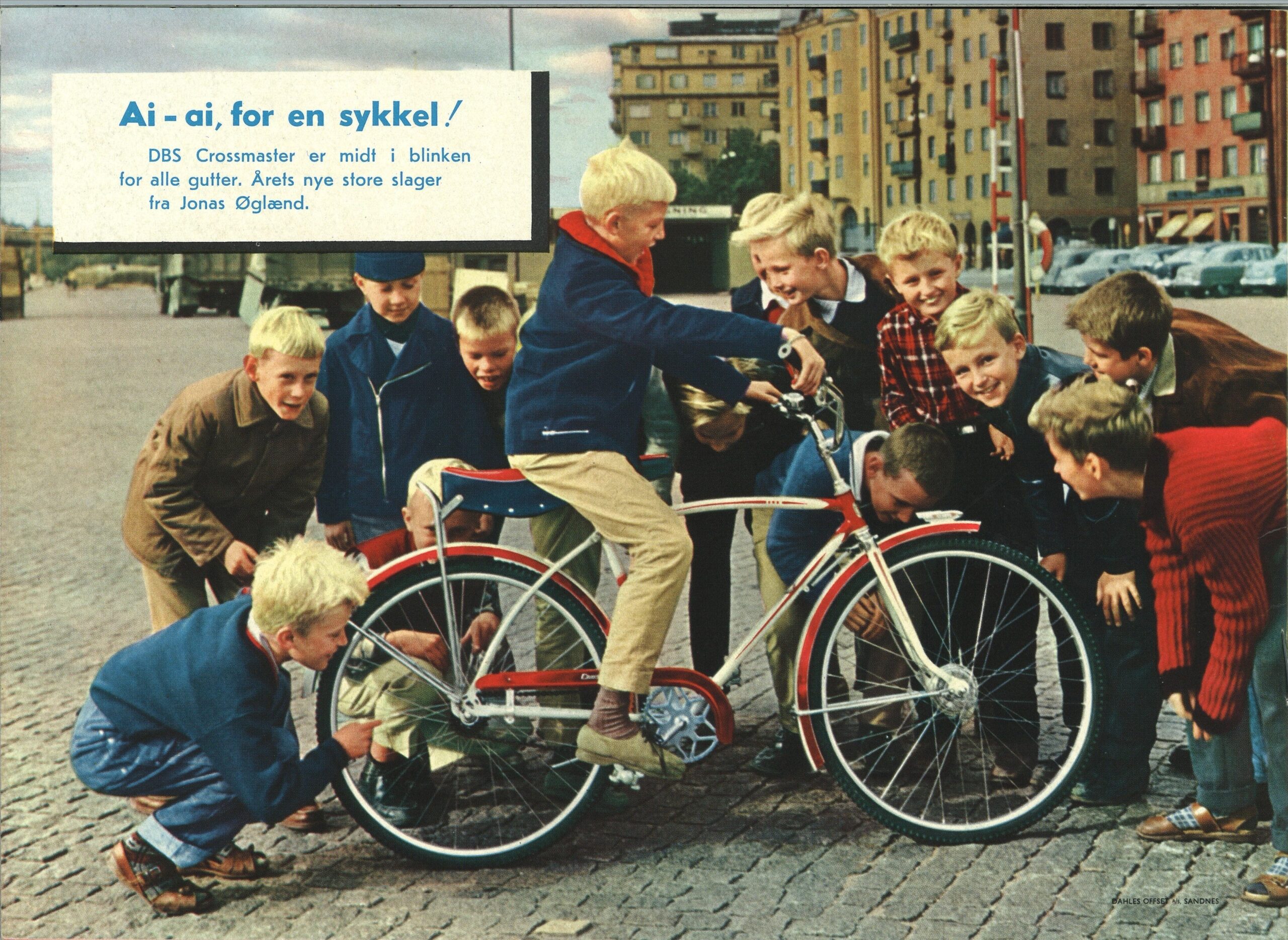
DBS Crossmaster comes on the market.
1962
Bicycle frame no. 2 million is produced.
1962
The Tempo Taifun military model is built in collaboration with the armed forces. A special edition with a lightly tuned 175 cc engine.
1964
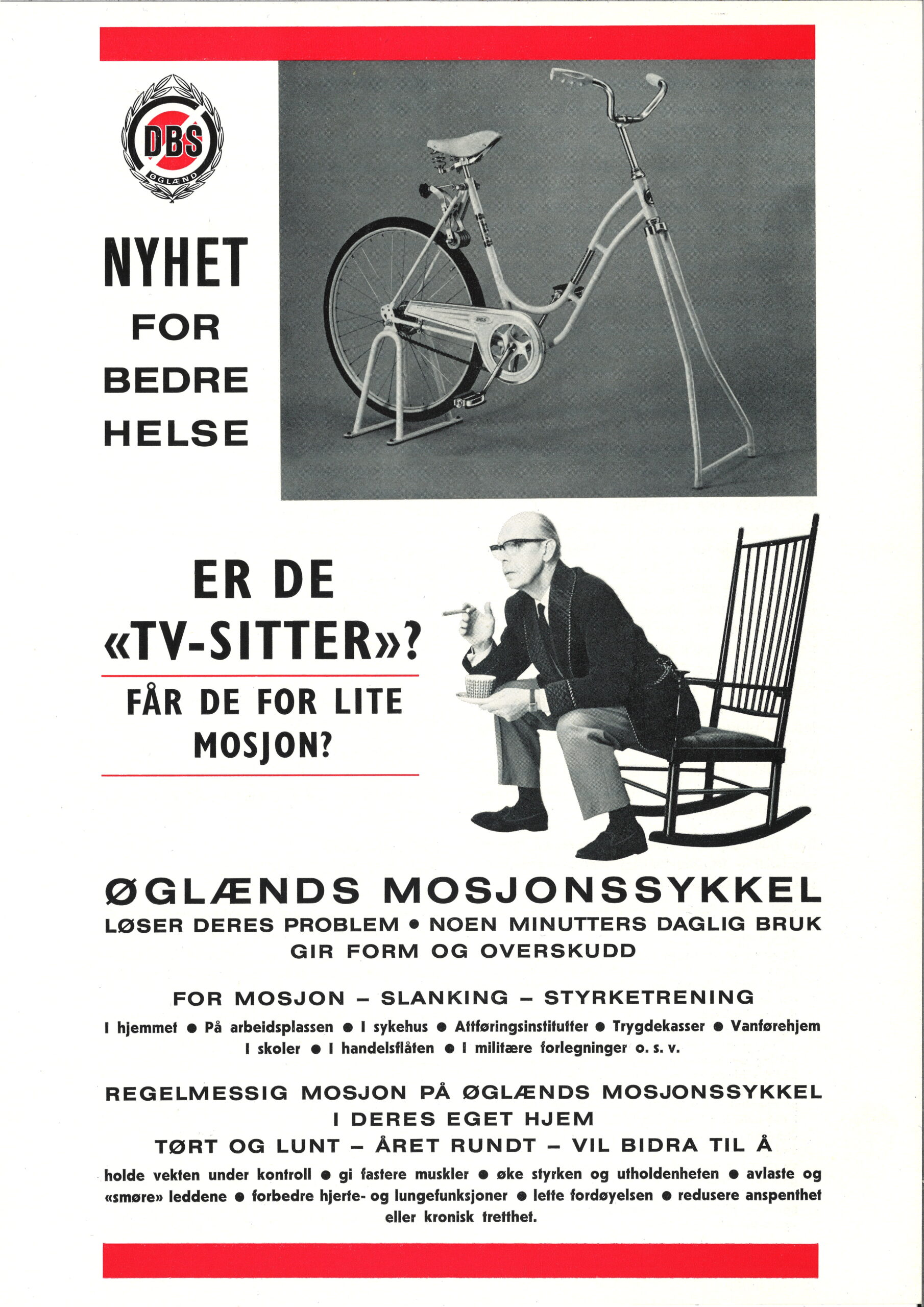
The first exercise bike from Øglænd.
1966
Øglænd Group becomes a limited company and
Jonas Bjarne Øglænd Chairman of the Board.
The «Donald Duck» tricycle is launched. This is a more luxurious model with a cargo area as standard equipment.
Tempo Panter is launched. Another legendary moped model from Øglænd.
1967
The first CEO outside the Øglænd family is hired - Martin T.
Tveit.
DBS Kombi is launched. The model is based on the former license production of the Moulton Mini bike. Production of the Kombi continued until 1987 and was a great success.
1968
Øglænd celebrates its 100th anniversary with big parties. The garment factory is transformed into a party venue with food for 2,600 guests.
For the first time, the bicycle factory starts up production of winter items. Polaris snowmobile and skibob are some of the products.
TESA collaboration. A technical collaboration between large manufacturing companies in Sandnes and Jæren is being formalized. They have a greater focus on electronics and robotization of production.
1968
Bicycle frame no. 3 million is produced.
1970
Øglænd's health and exercise products, marketed under the name «Bodyguard».
1971
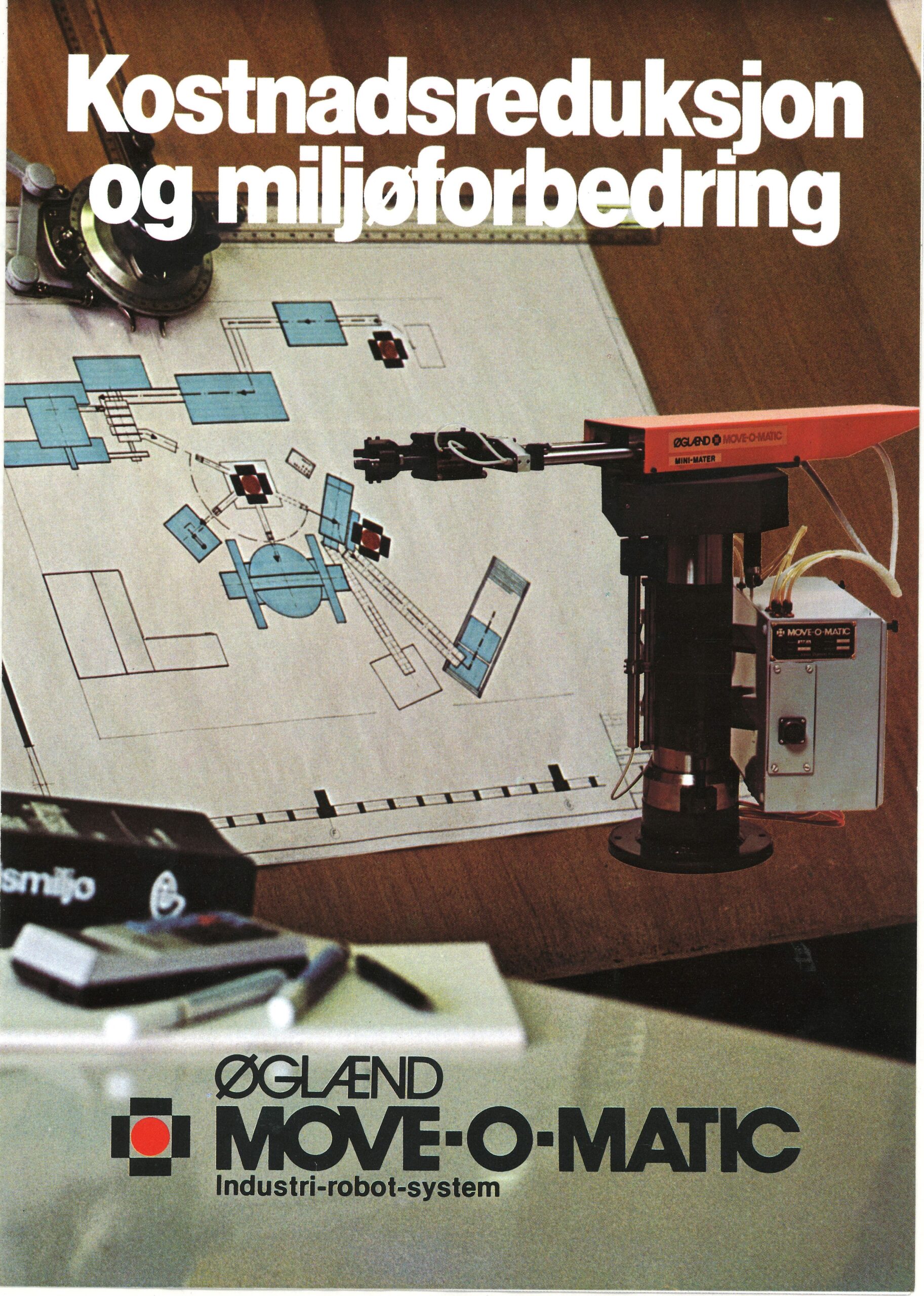
«Move-o-matic» robots are launched. Øglænd creates its own department for the development and marketing of advanced handling robots for use in industry. Later named Ø-Engineering. DBS Tomahawk is launched.
1972
Bicycle frame no. 4 million is produced.
1972
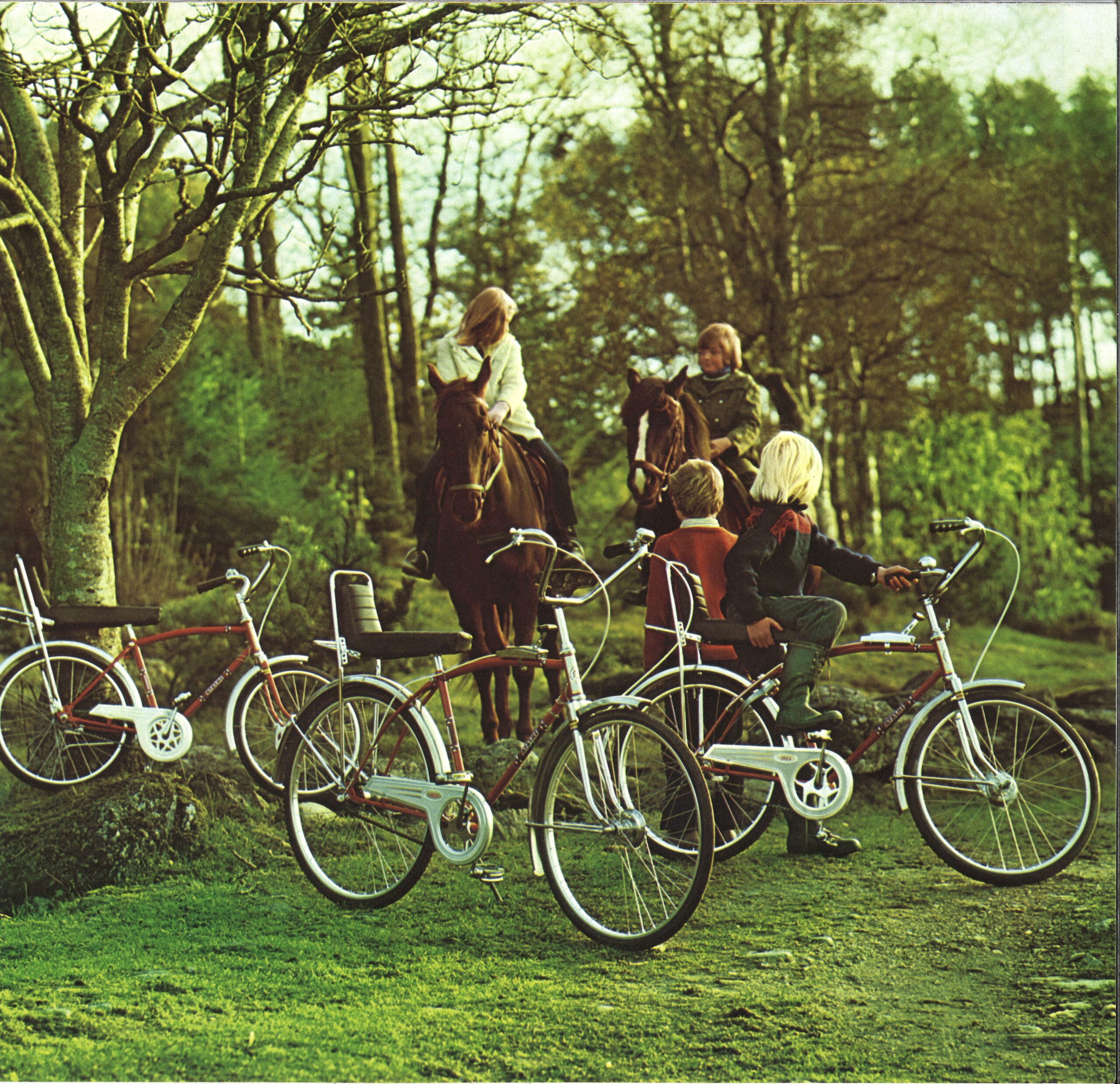
The «Apache» bicycle is launched and becomes very popular. It was produced until 1980. It was a further development of the Crossmaster.
1972
The first stage of construction at Kvål is completed. 23,500 square meters. Annual capacity on a single shift is 300,000 bicycle frames with final assembly of 200,000 bicycles, 50,000 children's tricycles, 10,000 exercise bikes and 10,000 moped frames.
Of Øglænd DBS's total sales, 60 % take place in Norway. The market share in the Norwegian bicycle market is 80 %, and the moped share is 60 %.
1973
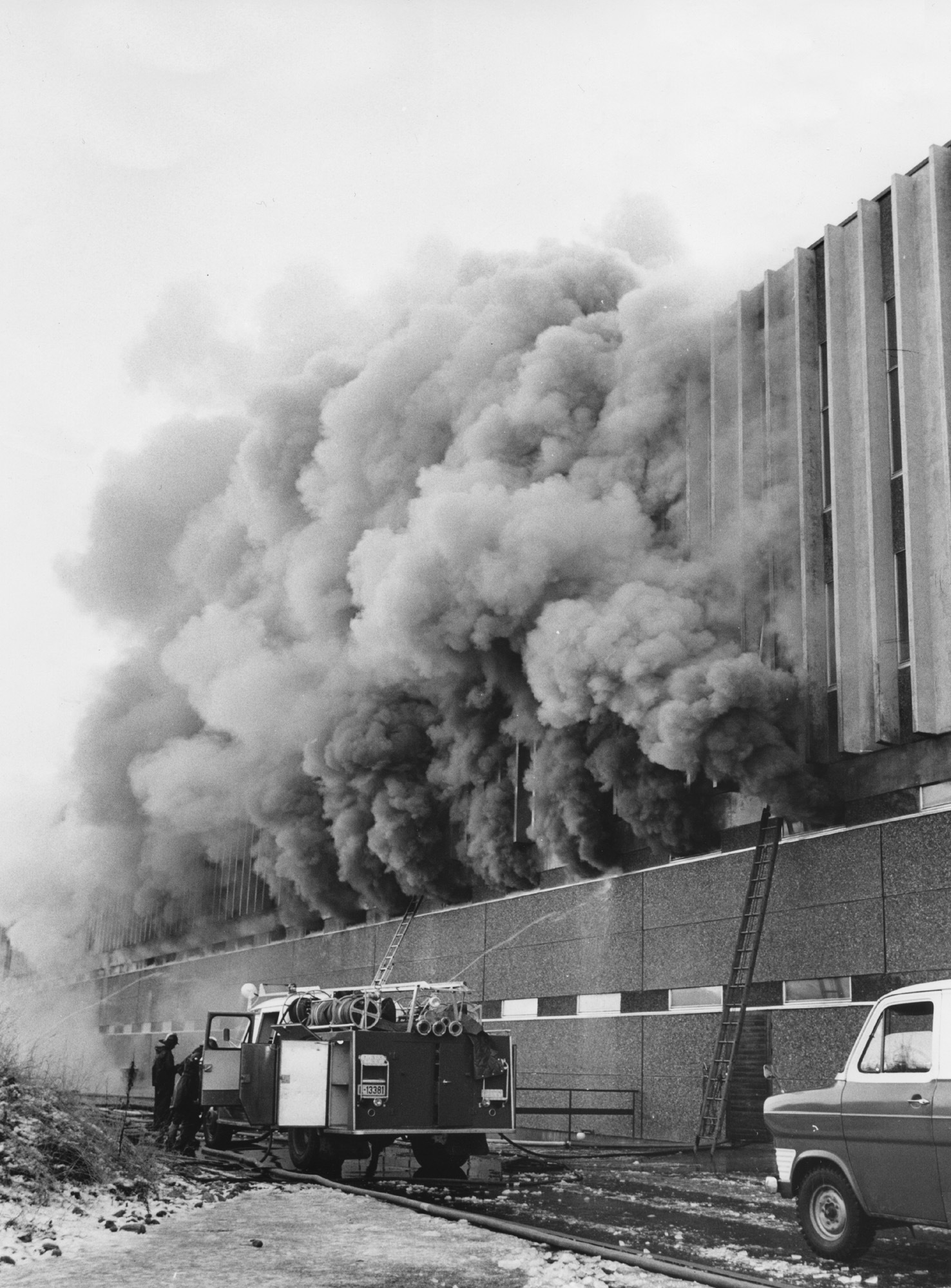
On November 16, a major fire breaks out at Kvål. 22,000 bicycles are destroyed and 8,000 bicycles suffer fire and smoke damage. The factory suffered major damage. A massive rescue operation is launched to get the factory up and running again. Only 7 weeks after the fire, all the wheels are running again at Kvål.
1973
The former bicycle factory in Solaveien 3 and 10 will become the shopping center «Huset Vårt».
1975
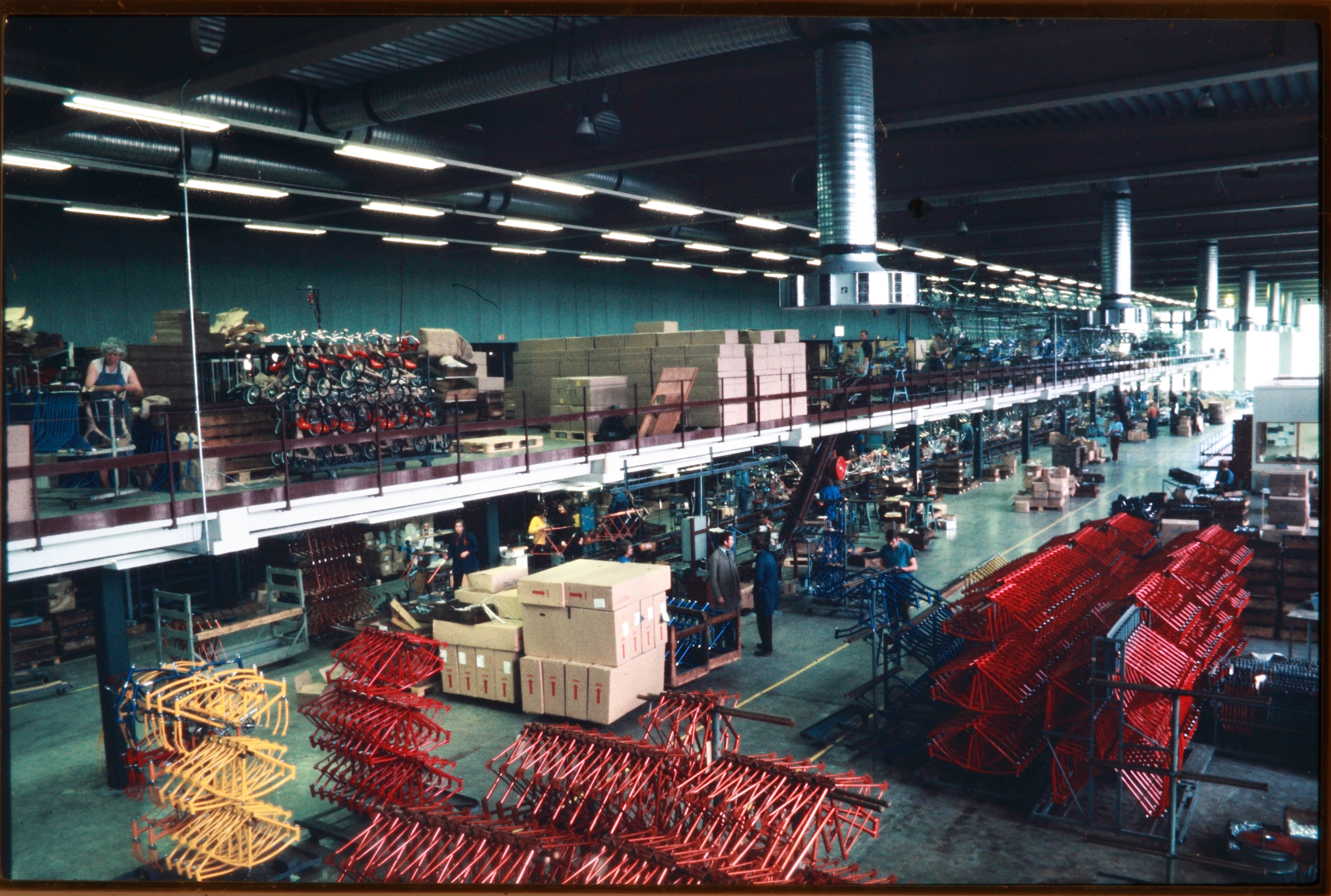
The year 1975 is a problematic year for Øglænd. Full stocks and poor sales mean that the company has to lay off more than 100 employees.
1975
Bicycle frame no. 5 million is produced.
1976
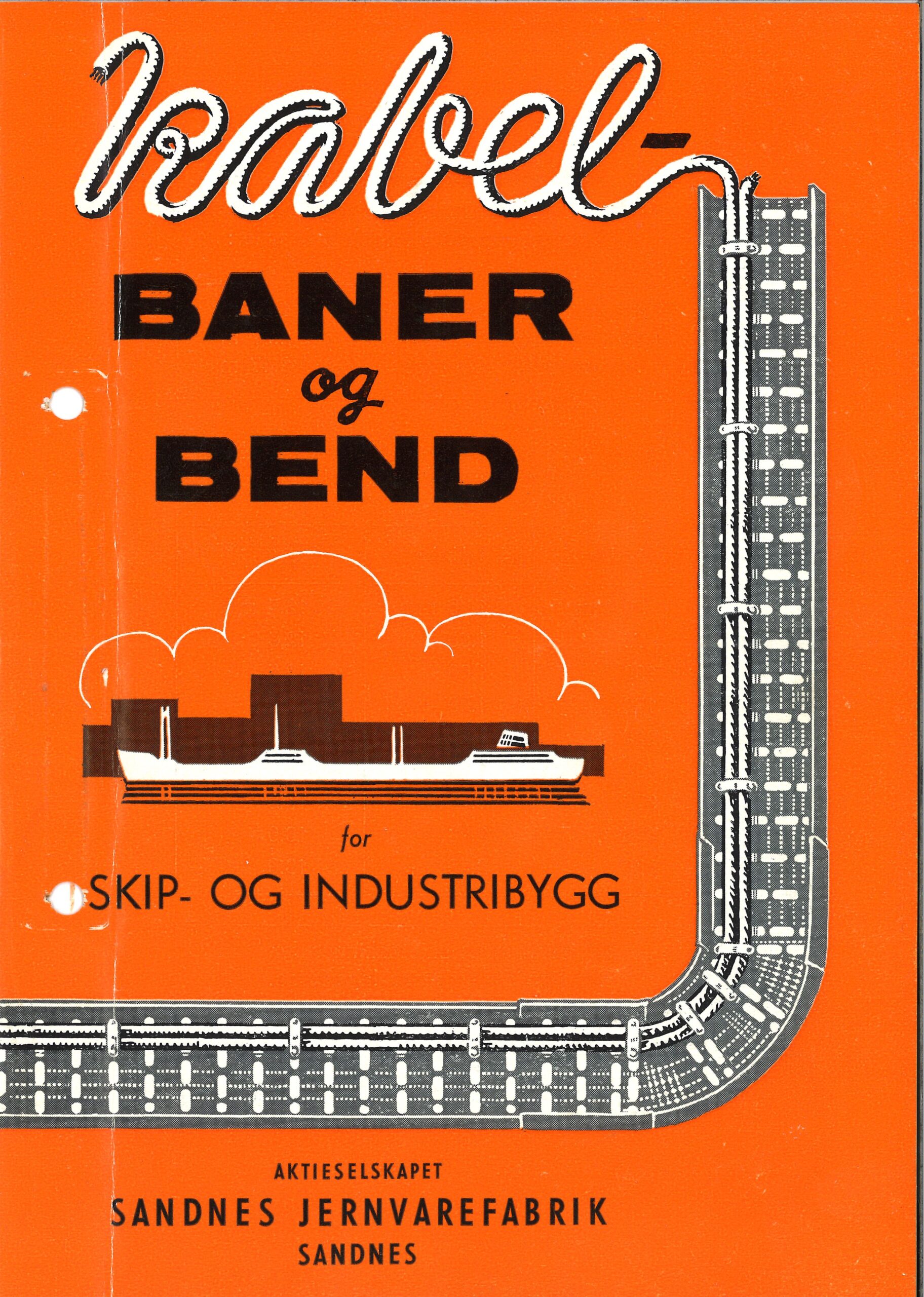
Øglænd AS acquires Sandnes Jernvarefabrikk. The factory has just started with
production of cable trays. This segment is of great interest to Øglænd, and
is added as a separate department in Ø-Engineering, led by Gunnstein Austigard. Later becomes Ø-system.
1978
Bicycle frame no. 6 million is produced.
1981
Bicycle frame no. 7 million is produced.
1981
The annual result shows a profit of NOK 62 million, which is the largest to date. The number of employees in the group is close to 2500.
1981
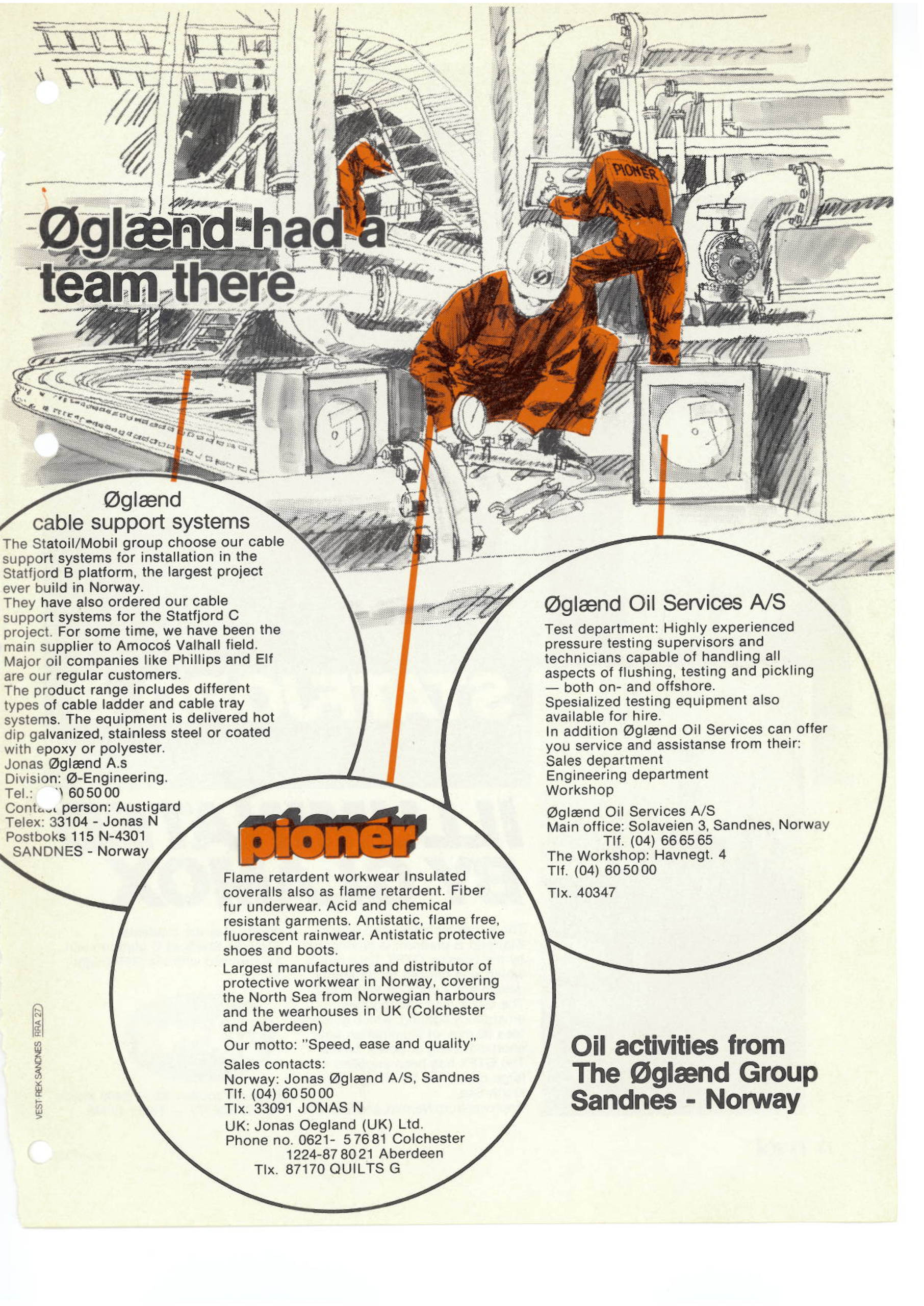
The Ø-system brand appears for the first time and wins deliveries to major oil installations. This year it was Statfjord C. The following year there were contracts with Elf, Frigg and Odin.
1982
The bicycle market share falls to 68 % of total sales in Norway.
1983
The total market for bicycles is falling throughout the Nordic region. The bicycle factory experiences heavy losses. The international consultancy firm McKinsey & Co is hired to create a market-oriented strategic plan and equip Øglænd for the future.
1984
The McKinsey report's main conclusions are to focus on bicycles and the retail chain. This arouses reactions, both internally on the board and among employees. CEO Per Hatling retires on May 1, 1984.
Senior manager Jonas Bjarne Øglænd dies, 89 years old.
Arne Norheim will be the new CEO.
Øglænd has approx. 40 % market share of total bicycle sales in Norway. The Øglænd family holds approximately 50 % of the shares.
1984
Bicycle frame no. 8 million is produced.
1986
The second stage of construction at Kvål is completed. Administration and sales are gathered in one place.
1987
This year 157,015 bicycle frames are produced. Øglænd accounts for approximately 50 % of total bicycle sales in Norway. The last Tempo left the factory this year, but the Tempo moped was still produced under license in Portugal and Italy.
1987
Dressmann A/S is the largest shareholder in Jonas Øglænd AS with approximately 19 %.
1988
Øglænd's fitness equipment business had sales of NOK 110 million, of which NOK 100 million was in markets outside Norway. However, the investment and the acquisition of Landice Products Co. in the USA cost and generated considerable profits.
1989
Øglænd discontinues its Bodyguard venture. The board of directors estimated that the business had incurred a loss of NOK 95 million since 1986.
Varner acquires all shares in Jonas Øglænd AS.
Øglænd DBS AS is sold to Swedish Monark AB for approximately NOK 85 million.
Øglænd Teknologi AS is sold to Trio Partner A/S.
1989
Bicycle frame no. 9 million is produced.
1990
Norsk Tempoklubb is founded.
1990
Arne Norheim resigns as CEO and Ivar Rusdal takes over the following year.
1991
Jonas Øglænd AS is merged into AS Varner Invest and changes its name to Varner - Øglænd AS. The last board meeting is held on February 20 and Øglænd ceases to be a separate company after 123 years.
Half of all DBS bikes produced are off-road bikes.
Øglænd System AS is sold to a local buyer group.
1994
Production of Tempo is discontinued. The last model is the Tempo Corvette 380 P. Produced in Portugal on the license.
1994
Bicycle frame no. 10 million is produced.
2000
Bicycle production at Kvål is discontinued. The last model was a DBS Kombi, a redesign of the legendary Kombi model from the 1970s.
2001
Production of DBS continues under the international cycling group Cycleurope.
2015
Øglænd system wins Johan Sverdrup contract for suspension systems, cable trays and cable ladders for four platforms in the Johan Sverdrup field.
2017
Ø-system is acquired by Hilti Group in 2017, but keeps the Øglænd name.
2018
Ø-system Gruppen is today an international group with 14 subsidiaries and three factories.